Downtown Phoenix Journal
  • Arts & Culture
  • Eats & Drinks
  • Style
  • Sports & Rec
  • Innovate
  • Live Here
  • Build Here
  • Engage

Central United Methodist Church

Song in Three Forms

Posted on 4/25/13 by Katrina Becker » No Comments

MusicaNova Orchestra in rehearsal at Central United Methodist Church
(credit: Elizabeth McKinnon)

Music protesting war and violence takes many forms — from 20th century songs like Metallica’s hit “One” and Sting’s “Russians” to earlier expressions by Bob Dylan, Peter Paul and Mary, and Joan Baez. And long before John Lennon and Pete Seeger made their mark, classical composers were objecting to conflict; for example, Benjamin Britten with his War Requiem and Krzysztof Penderecki with his Threnody for the Victims of Hiroshima.

Composer Ralph Vaughan Williams

English composer, teacher, writer, and conductor Ralph Vaughan Williams brought his own style of protest and commentary to his interpretation of the Roman Catholic Mass, Dona nobis pacem (“Give us peace”). Written in 1936 and 1937, the cantata uses text from the Bible, a parliamentary speech by British statesman John Bright, and verse by Walt Whitman.

“Dona nobis pacem was written in the dark days of the late 1930s as another European war loomed,” explains MusicaNova Music Director Warren Cohen. “Although the last section ends hopefully, the quiet ending suggests that perhaps he [Vaughan Williams] saw that things were not so hopeful in 1936.”

The six-part work includes martial drums and bugles followed by the mourning of a movement titled “Dirge for Two Veterans,” and through it all a solo soprano voice rises in entreaty. “This plea for peace is emotionally direct…[and] can be seen as a plea for sanity,” says Cohen.

This evening, he leads MusicaNova Orchestra in a performance of Dona nobis pacem and other vocal works in a program called And Open to All: Opera, Oratorio, and Song at Central United Methodist Church. The combined choirs of Arizona School for the Arts and Central United Methodist Church join the orchestra (full disclosure: I’m one of the musicians).

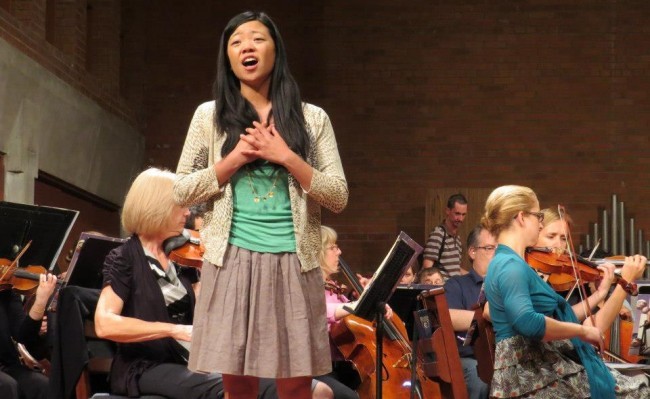
Soprano Joyce Yin with MusicaNova Orchestra
(credit: Elizabeth McKinnon)

Soloists include singers from a newly-formed Valley organization called Opera Revolution, an offshoot of the music advocacy group Classical Revolution Phoenix, which offers casual, free performances in non-traditional venues as well as the annual Classical Revolution Phoestival. The performers include Karen Hendricks Crawford, Daniel Kurek, Susan Hurley, Andrew Briggs, Joyce Yin, John Cleveland, and Robert Altizer.

“This concert is an exploration of diversity within vocal music,” says Cohen, who has a very personal interest in song since he’s married to a soprano. He chose not only the large, introspective work by Ralph Vaughan Williams but also an assortment of art songs from the late 19th and early 20th centuries as well as a classic operatic scene.

“The songs represent five separate and distinct visions of the subject of desire and love,” he continues, describing works by Richard Strauss, Hugo Wolf, and Aldo Finzi. “From the expression of lost love in ‘Allerseelen (All Souls’ Eve)’ through the psychopathic manipulation of ‘Der Rattenfänger (The Rat-Catcher)’ –  based on the Pied Piper of Hamelin — to the glow of ‘Morgen (Tomorrow),’ the anxious puppy love of ‘Cäcilie,’ and the longing of ‘Catharine,’ each song represents a radically different take on the subject.”

MusicaNova in rehearsal (credit: Rogerio G. Araujo)

The program’s operatic excerpt is an ensemble scene from Mozart’s Don Giovanni, set at a party hosted by Giovanni himself, who hopes to seduce the country girl Zerlina in the course of the evening. They’re joined by Zerlina’s fiancé, Giovanni’s servant, and three masked strangers who secretly seek revenge against the seducer.

Musically, the scene features multiple voices and three instrumental ensembles, and at one point three different dances — a waltz, a quadrille, and a minuet — overlap in carefully engineered chaos “as Mozart anticipates the experiments of Charles Ives by 125 years,” says Cohen, whose adventurous programming has won him an award from the American Society of Composers, Authors, and Publishers (ASCAP) and the American Symphony Orchestra League (ASOL).

“[It’s] a tour-de-force of complexity,” he concludes. “The seven voices appear in the guise of soloist, duet and trio partners, and ensembles, sometimes tripping over each other as the various operatic conventions run almost simultaneously.”


If you go:

Event: And Open to All: Opera, Oratorio, and Song

When: Thursday, April 25, 7:30PM

Where: Central United Methodist Church sanctuary, 1875 N. Central Ave.


Tags: Aldo Finzi, Arizona School for the Arts, Central United Methodist Church, choral, Classical Revolution Phoestival, Classical Revolution PHX, concert, Hugo Wolf, Mozart, MusicaNova Orchestra, orchestra, Ralph Vaughan Williams, Warren Cohen
Posted in Arts, Arts & Culture, Culture, Live Music, Midtown |

‘Four Hands, Two Hearts, One Piano’ Playing Bach

Posted on 1/12/13 by Katrina Becker » No Comments

Johann Sebastian Bach (portrait by Elias Gottlob Haussmann, 1748, after an original of 1746; photo by Willard Starks)

The Arizona Bach Festival continues its third season of performances through this weekend with an organ recital, a chamber orchestra performance, and last night’s unusual piano duo program of Johann Sebastian Bach’s Brandenburg Concertos.

When German organist and composer Max Reger arranged the concertos – originally written for various configurations of strings, winds, and harpsichord — for piano four hands between 1905-1906, he was taking another step in a long tradition. Bach often rearranged his own works for different instrumentations, recycling his melodies and themes over the years, and he was one of Reger’s favorite composers; “Bach was his big, big idol,” says pianist Eckart Sellheim. “Bach, Beethoven, Brahms…those three…were Reger’s spiritual and compositional mentors.”

Dian Baker and Eckart Sellheim

A former professor at the University of Michigan and Arizona State University, Sellheim has served on the faculty and as guest lecturer at conservatories across Germany, earning a respected reputation for historical performance accuracy, with a particular interest in the fortepiano (the modern piano’s predecessor). He and his wife, collaborative piano specialist Dian Baker, performed three of the six Brandenburgs last night at Central United Methodist Church.

The appeal of the Brandenburgs is complex, says Sellheim. “It’s this mixture of very recognizable melodies…the rhythm, the incredibly clear structure, and the beauty of the slow movements.” He elaborates, “They’ve become sort of a main staple of the repertory, and many people grew up with them.”

Bach wrote the six concertos in the early 18th century for the noble court in Brandenburg, a northeast German state. Perhaps because of its difficulty, his music languished unheard for over a century, but today it’s nearly as popular as Vivaldi’s Four Seasons.

Max Reger and friend

Max Reger systematically studied Bach’s keyboard works and also created numerous transcriptions and arrangements of music by composers ranging from Bach to Hugo Wolf, his own contemporary. A friend of Richard Strauss and Hans Pfitzner, Reger is sometimes considered the musical link between Brahms and Schoenberg. “He was highly controversial,” says Sellheim. “He ventures out into unknown fields, particularly the piano music, but never crosses the line.”

“You have to realize,” he continues, “it was an incredible time around the turn of the century, 1900 – there was Wolf, and Strauss, and Ravel, and Debussy…they changed the course of music.” Born in 1873, Reger was a renowned organist known as “the second Bach” because of his keyboard skills. His compositions include modulations and structure flirting with 12-tone rows, but looking back to Baroque and Classical styles.

“Reger had no sympathy for the harpsichord,” Sellheim says, “but Bach on the modern piano is really no problem at all – it works very fine.” Reger’s transcriptions are hugely challenging for the performers – according to Sellheim, the composer said he had the “greatest fun” writing them, interweaving complex lines from numerous instruments into just 20 fingers on a single keyboard.

Excerpt from primo part, first movement, Brandenburg Concerto No. 5 (Bach/arr. Reger)

“It’s fun to play,” he adds, “and as always Bach is so enticing and so interesting, fascinating…not only in the technical and musical aspects, but also rhythm.” Sellheim pauses. “The feeling is always that Bach goes back to the core of music – he makes us clean and clear…it’s so revealing.” He laughs. “The cleaning process makes you sober, if you’re not sober before, and gets you back to the origins…you need to confess something – there is no hiding. Everything is completely open.”

The Festival’s president, Arizona native Scott Youngs, created a seven-year “American Bach” series in his position as director of music at All Saints’ Episcopal Church and Day School. After offering more than 50 cantatas along with Bach’s St. John and St. Matthew Passions, he continued by developing the Festival, a non-profit organization with its own board.

“We strive to present Bach’s music in a variety of ways,” says Youngs. “The music is so versatile and today’s taste so eclectic that we don’t feel constricted by any convention. At least one concert each year is slightly ‘off the wall.’” He continues, “This year’s concert for piano four hands…some portions are strictly from Bach’s scoring, and some portions are…through a much more Romantic and contemporary lens. Lots of notes!”


 If you go

Arizona Bach Festival:

  • Friday, January 11, 7:30PM at Central United Methodist Church, 1875 N. Central
    Eckart Sellheim and Dian Baker play Reger’s transcriptions of Bach’s Brandenburg Concertos
  • Saturday, January 12, 3PM at All Saints’ Episcopal Church, 6300 N. Central
    David Enlow performs a dramatic recital on the Visser tracker organ
  • Sunday, January 13, 3PM at Camelback Bible Church, 3900 E. Stanford Dr., Paradise Valley
    The Festival Chamber Orchestra welcomes violin soloist Stephen Redfield and flute soloist Elizabeth Buck

Tags: All Saints' Episcopal Church, Arizona Bach Festival, Brandenburg Concertos, Central United Methodist Church, chamber music, Dian Baker, downtown phoenix events, Eckart Sellheim, Elizabeth Buck, Johann Sebastian Bach, Scott Youngs
Posted in Arts & Culture, Culture, Festivals, Live Music, Midtown |

Sign up
for the DPJ Newsletter:


Your Guide as you Explore Your Core

Whether it’s community news, food, shopping or sports, let the Downtown Phoenix Journal be your guide to an urban lifestyle. We offer a friendly, straightforward insider’s view of all things Downtown Phoenix. From world-class restaurants and museums to events to plan your day around, the Downtown Phoenix Journal is your guide as you Explore Your Core.

Downtown Phoenix Journal is powered by Urban Affair.

Sitemap

  • home
  • eats & drinks
  • arts & culture
  • style
  • sports & rec
  • innovate
  • live here
  • build here
  • engage
  • - About Us
  • - Contact
  • - Advertising

Get to know
DPJ

© 2013 Downtown Phoenix Journal - all rights reserved. Site developed and powered by Invexi
rssBlog Entries • Comments • Sitemap