ASU Campus
Wire | City Council Approves First Step in Developing ASU Center of Law
Posted on 12/12/12 by DPJ Staff » Comments Off
DPJ’s Wire series delivers news and information straight from the source without translation.
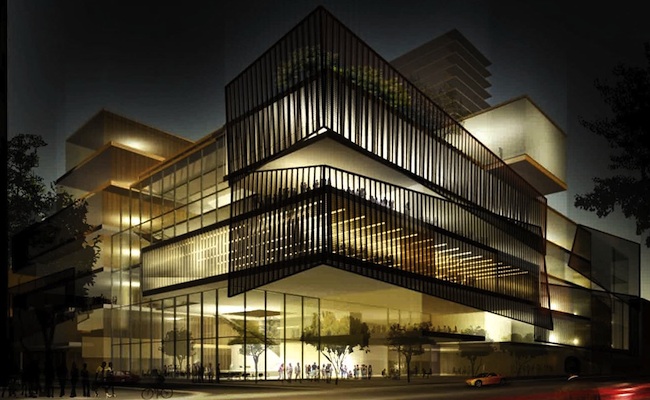
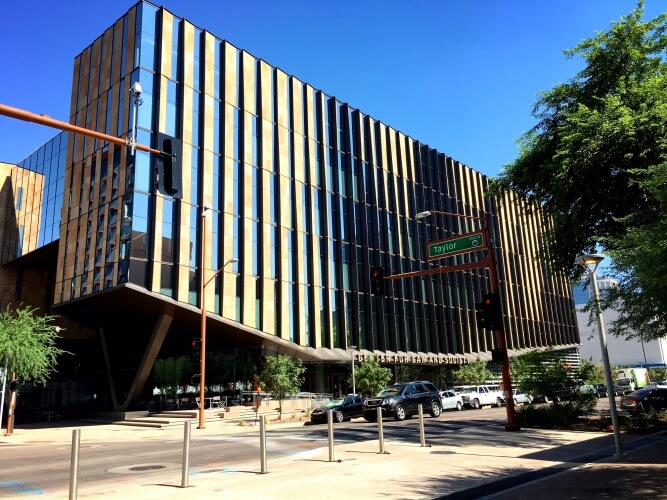
The Phoenix City Council last week approved city staff to begin negotiations and enter into contracts to facilitate Arizona State University’s development of the Arizona Center for Law and Society on city-controlled property in downtown Phoenix.
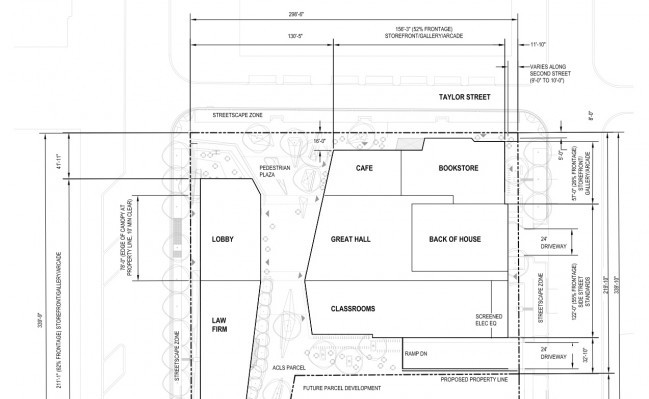
ASU proposes to develop the Arizona Center for Law and Society on approximately three-quarters of a block of city property bounded by Polk, Taylor, First and Second streets.

Conceptual rendering of the future Arizona Center of Law and Society. A design team has yet to be selected for the project, and construction is scheduled to begin in Spring 2014. The center is scheduled to open in Spring 2016. Image courtesy of ASU.
“Thank you to ASU, President Crow, my fellow council members and the Arizona Board of Regents for working so diligently in making this innovative move to our growing downtown Phoenix urban core,” said Mayor Greg Stanton. “This is more than just a move – it’s a major part of our city’s and region’s future and a place where ideas from some of the best law students in the country will contribute to our justice system and make Phoenix and Arizona a better place to live for generations to come.”
In addition to the hundreds of ongoing professional jobs created in Phoenix by this investment, approximately 1,000 construction-related jobs and $1 million in construction sales tax will be generated.
“Locating the College of Law in downtown Phoenix is a perfect match that will enhance the vibrant university campuses, create jobs and provide real-world educational benefits and opportunities for the law students,” said Vice Mayor Michael Johnson, chairman of the City Council’s Downtown, Aviation, Economy and Education Subcommittee.
The approximately $100 to $120 million, six-story facility will include the Sandra Day O’Connor College of Law in approximately 250,000 to 300,000 square feet, as well as continuing legal education facilities, community legal services, public retail amenities and approximately 200 to 250 parking spaces.
“This is an investment that makes sense for ASU College of Law, its students and the city of Phoenix,” said Councilman Bill Gates. “The move will position one of our nation’s top public law schools within walking distance of local, state and federal courts, our state’s top law firms and business headquarters.”
“We are deeply grateful for the support we have received from Mayor Stanton and members of the City Council for our relocation to downtown Phoenix,” said Douglas Sylvester, dean of the Sandra Day O’Connor College of Law. “We are excited about the opportunity to be situated in what has become the legal, government and corporate center of not only Phoenix, but of Arizona as a whole, and for the opportunity to further embed ourselves in the downtown community.”
Construction of the project is scheduled to begin in Spring 2014, completion of construction in late 2015. The center is scheduled to open in Spring 2016.
Meet Thuy An and Cortney, Fashion Department Interns
Posted on 1/14/12 by DPJ Staff » No Comments
With the launch of the fashion department at DPJ, the need for interns is critical. We are thrilled to introduce our interns, Cortney Kaminsk and Thuy An Bui, both students at ASU’s Walter Cronkite School of Journalism and Mass Communication.
During their internships, Cortney and Thuy An will be running around town assisting photo shoots, pulling samples and blogging for DPJ, all while documenting their experiences via Twitter on the fashion department’s account, @Seamless_AZ.
Name: Cortney Kaminski
Age: 20
Hometown: Glendale, Arizona
College: Arizona State University
Major: Journalism (Print)
Why are you excited to work in the fashion department of the Downtown Phoenix Journal?
One reason, I am working directly under Corbin who is quite a name in the industry. Two, with this internship I am able to gain hands-on experience, which is extremely valuable in this industry. Three, since the Journal is a fairly young publication, it is exciting to be able to get on board early and really be involved in every aspect of it.
How did you break into the internship?
It is all quite a blur as everything really happened quickly. I mean on Tuesday morning I was sitting on a bench interviewing with Corbin, and then Thursday I was laying out accessories at the cover photo shoot.
What was your first day on the job like?
My first day was quite nerve-racking but thrilling at the same time. It was a great day to start on, being that there was a shoot. It was only my second time at one and it was definitely exciting to be able to actually work with the stylist and assist throughout the shoot, I just wish I didn’t have to leave early for class.
What are some of your responsibilities at DPJ?
Working at DPJ is a different experience, in the way where I don’t feel I have a ton of certain responsibilities. It is more of an “assist here” or “write this” type of internship. Of course, there will be the usual fact-checking, interviews and writing, but I also am able to be at the photo shoots and really be hands-on. I also am able to help with the DPJ fashion section’s social media, which is always a fun yet a little daunting task. When you just start out in a new work environment the first few weeks are always more dipping your toes into the water until you get a feel for how everyone works there.
Favorite designers?
Alexander McQueen. I have always sworn that when I get my first big pay check the first thing I will buy will be an Alexander McQueen piece. A few other notables would have to be Maria Grazia Chiuri and Pier Piccioli of Valentino, Giles Deacon of Ungaro and Matthew Williamson. I will definitely be adorned with these designer frocks in the future!
Name: Thuy An Bui
Age: 19
Hometown: Phoenix, Arizona
College: Arizona State University
Major: Journalism (Print) and Design Studies
Why are you excited to work in the fashion department of the Downtown Phoenix Journal?
I’m unbelievably excited to be involved in a flourishing community like Downtown Phoenix where fashion still thrives among us. I’m looking forward to gaining a firsthand experience by observing the inner workings of the fashion department at DPJ.
How did you break into the internship?
I heard about it from the VP of the Fashion Journalist Club at ASU and decided to simply apply.
What was your first day on the job like?
Fun! Nothing like the usual paperwork signing but instead, we jumped right into helping with a photo shoot. I mainly helped the stylist by organizing the beautiful clothes and accessories and dressing the models. It was inspiring to see how everything played out and what process everyone has to go through.
What are some of your responsibilities at DPJ?
My job ranges from a spectrum of different tasks including assisting with the fashion photo shoots, updating and maintaining the twitter account @Seamless_AZ and and assisting Corbin, the Fashion Editor of DPJ.
From the Mag | Forward Thinking with Michael Crow
Posted on 12/16/11 by DPJ Staff » No Comments

(From the Mag brings you excerpts and continued conversations from DPJ Magazine, a bi-monthly print publication distributed throughout Greater Downtown Phoenix and beyond. Find the rest of the interview with President Crow in the latest edition DPJ Mag, now available online.)
Arizona State University President Michael Crow talked about the vibrancy and design of the city’s center with DPJ guest editor David Leibowitz.
David Leibowitz: How important should good design be to the city of Phoenix?
Michael Crow: Design is essential; it is adaptation to place to make all the natural features of the place work to our benefit. The desert is naturally cooling at night, as opposed to the city which is naturally heat absorbing. If we can change our design, our structure, we can change the cost basis for air conditioning. We can maintain species. We can change water transpiration rates. We can change the way the city works, both environmentally and economically and from the livability prospective itself.
We have a tremendous opportunity to use design to our advantage to enhance livability. Now, it’s already livable. How do you make it fantastically livable so that everybody wants to be here? The attrition rate is not trivial. Lots of people come, they experience the summer, they experience what happens at night, in the morning and then they leave. Imagine those people not leaving and being able to attract anyone to a fantastically livable place. We’re going to have to design and engineer some of that to make it work.
DL: How might Phoenix be engineered differently?
MC: We have a range of ways that we can engineer surfaces. We can engineer rooftops, shade structures. We could engineer buildings that change the nighttime heat index problem. That means we have to think it through. We have to build a unique city rather than just a transplant city. And that requires rethinking design, rethinking materials, rethinking structures. And from that you’ll be able to have the city grow without becoming a place that never goes below 95 degrees at night. Or eventually never goes below a hundred.
DL: Where are we in the continuum of downtown evolution?
MC: I think we’re still in the early stages which is good; we’ve got high energy in the early stages. I do think the progress will continue; I think it really needs to continue. And I think that we’re early and that’s good, because that means we’ll be able to take advantage of renewable energy technologies. We’ll be able to take advantage of advanced nano materials. We’ll be able to take advantage of new engineering techniques. All of which could make Downtown Phoenix into an absolutely unique kind of venue. It has many of these now and it’s done very, very nicely up to this point. We need to keep all that going.
DL: You have said that Phoenix’s competitive advantage is ours to lose. What did you mean by that?
MC: We have all of the natural assets. We have a beautiful location, beautiful place, relatively happy environment, a successful ability to advance, to do things, to make things happen. So, we have to figure out how to make all of that work. And in making all of that work, with all the natural assets, it’s going to extend our competitive advantage. It’s ours to lose. If we don’t figure out how to urbanize, if we don’t figure out how to fill the Central City, if we don’t figure out how to build intensity, then we will lose to other places that have fewer natural advantages.
Downtown needs to become a place of visually intense energy. And that’s an energy hung in between sectors or groups. Sports, finance, education, business, technology – all those things are required to make a vibrant downtown.
Desert Dreams
Posted on 9/21/11 by Eileen Brill Wagner » No Comments

What project would you dream up if you had $100,000 to spend?
For students in ASU’s American Humanics program, that dream is now reality with the ribbon-cutting ceremony for the Encanto Garden of Dreams at Encanto Park this Friday at 8 a.m. The Garden will be an education center for youth from area schools, nonprofits and other organizations to learn about low-water usage vegetation, the need for conservation and sustainability in our desert environment. Funded by the W.K. Kellogg Foundation, it is a collaborative effort of the American Humanics program, part of the ASU College of Public Programs; the ASU Lodestar Center for Philanthropy and Nonprofit Innovation; and the City of Phoenix’s Parks and Recreation Department.
An Ongoing Project
“Even though the grand opening is on Friday, technically it will never be completed,” said Tiffany Bailey, a senior in the American Humanics program, who has headed up the project for the past 1 ½ years. “There will constantly be new projects going on.”
The hope is that this unique area, located west of Enchanted Island, bordering the parking lot, will become a well-utilized community space. It has seating walls, an abundance of open areas, surrounded by mesquite trees, agaves, yuccas and other plants.
Bailey noted ASU is setting up a request for proposal (RFP) process so community groups will be able to apply for funding for service projects that benefit the Garden.
“It’s cool on both sides,” she said. “Now students will be able to be on the other side, learning about approving grants.”
A Different Vantage Point
While Encanto Park was not the original destination for the Garden—the students were looking at what is now Civic Space—it ended up being the perfect fit for the underused Cactus Garden, according to Jan Sherwood, City of Phoenix’s Park Manager for Encanto Park. Maintenance needs are low, she added, because of the drought-resistant plants and desert landscape.
“It certainly brings a new viewpoint to the park,” Sherwood said, who added it was “kind of a weird area” in the middle of the grass, but not necessarily a destination unto itself. Now it’s an area where you can do lesson plans and talk about conservation issues. It’s also very serene, a great place for reflection,” she said.“We’ve always enjoyed great community involvement and the Garden is an extension of this.”
Embedding ASU in the Community
The project first took root at the 2008 American Humanics Management/Leadership Institute. At that time, the W.K. Kellogg Foundation asked a group of ASU American Humanics students what they would do if they had $100,000 to spend. In response, the students submitted a proposal to create a community space which ultimately became the Encanto Garden of Dreams. ASU Lodestar Center not only helped secure the grant, but has provided both fiscal and programmatic assistance to the students.
“It ended up doing what it was designed to do—bring multiple groups of people that have community care together,” said Dan Minton, program coordinator senior for the Lodestar Center.
He said it will provide an opportunity for students to go out and meet with youth from local nonprofits to collaboratively work on educational projects. There’s no question it’s already been an education for the students involved. Bailey said this has been a major learning experience for her—from purchasing materials to working with a budget and learning how to stage events.
“This project involved a number of people and organizations that made it possible and, thus, provided a terrific laboratory for students to learn about community development,” said Dr. Robert Ashcraft, Executive Director of the Lodestar Center. “Students learned about how to take ideas, adapt to community needs and wishes, collaborate and negotiate in ways that have resulted in something everyone can be proud of.”
But, beyond the education, for ASU, the Garden embodies a broader goal of being an integral part of the community it serves.
“For our Center, this has meant we can demonstrate community impact by not just talk or only through hypothetical case studies,” Ashcraft said. “Establishment of the Garden means our students, our ASU Lodestar Center and the University are socially embedded in the community in ways that advance the quality of life for citizens.”
June/July Issue of DPJ Magazine
Posted on 6/07/11 by DPJ Staff » No Comments
DPJ magazine’s June/July issue is hot off the presses and ready to celebrate a HOT summer. Pick up a copy at one of 300+ locations in and around the Greater Downtown area. Just a few of the issue highlights:
- Welcome | Meet Guest Editor David Leibowitz and read about his love of Downtown Phoenix
- All-Star BUZZ | Check out the rundown of MLB All-Star Week Festivities, taking place right here in July
- All-Star Regular | Read Leibowitz’s interview with Arizona D-Backs’ Luis Gonzalez and get his take on Downtown
- Paving the Way | J. Seth Anderson’s gets the scoop on a cool new parking lot innovation
- Core Values | Tazmine Loomans gives an account of her interesting conversations with the mayoral candidates
- Eats & Drinks | Justin Lee explores the core and more, helping identify the ideal culinary itinerary for locals and visitors alike
- District Beat | Courtney McCune takes the pulse of the city in a new section that celebrates the haps that make Downtown great
- Centerfold Map | Peruse a four-page, pull-out map and visit some new places on your next First Friday adventure (or any day of the month!)
- Stay up to date on all of the latest Downtown buzz and events, including Phoenix Convention Center’s record summer, the opening of the new Torch Theatre…and more!
If you haven’t picked up an issue, click below for an online view!